Managing Momentum or Managing for Success Important - By Rick Williams

Follow Rick Williams on LinkedIn

Are you managing momentum or managing and leading for success? Success next year and five years from now.
Most of our management and leadership time is consumed by operating today’s business. Maintaining current revenue streams, cutting costs, developing staff, keeping key customers happy, staying current with financial obligations, and not running out of cash.
Yes, your job as the leader of the company, division, group, or non-profit is to keep the business running – managing momentum.
Here is my challenge question. Are you managing momentum or managing for success?
You could say, “What is the difference?” There is a big difference between optimizing performance today and leading your organization to success tomorrow.
Everyone is talking about AI and how AI will change how work is done. There will be winners and losers. This is a moment similar to when laptop computers or smartphones became widely available. AI will change how companies compete, operate, and offer value to their customers. If you are not bringing AI into your company as a tool for its future success, it will fall behind, regardless of how successful it is today.

Your job as the leader of your organization is to make decisions today that will create the future for your company tomorrow. Your job is not to know exactly how your company should be using AI tools. Your job is to lead your team, at many levels, to ask, discover, learn, and decide how you might, could, and should use AI to make your company more successful a year and five years from now.
Here are two quick examples of companies with very successful operating models. They managed momentum well, but collapsed when they did not adapt to the changes required for future success.
Blockbuster: Blockbuster rented videos for viewing movies at home. As digital streaming technology came online, Blockbuster stuck with its cash cow. As Netflix started to gain momentum, Blockbuster passed on entering the digital video market by buying Netflix. Eventually, digital streaming killed the home rental video business.
Polaroid: Polaroid owned the instant camera business and was highly profitable. Polaroid invested heavily in digital photography and could have been an early entrant into the digital camera market. Because they did not want to compete with their instant film business, Polaroid did not introduce digital cameras. They went bankrupt after Sony and others entered the market with digital cameras and killed most of the instant camera business.
Manage today’s momentum. Also, look to the future. What will be required for success tomorrow? What must you do today to discover what companies like yours must be doing tomorrow to be successful?
The profile of success will differ across business and industry sectors. Obvious drivers of change will be:
- Who is spending and what are they buying?
- How will AI change your business model?
- How will changing demographics change who is buying and who is working?
- How will trade barriers and trade economics change your supply and market opportunities?
- How will changing energy production technologies and the cost of energy change your business model?
- Where will your employees do their work?
Yes, imagining the future is hard to do – even for a business you know well.
Engage with your leadership team and key advisors. Be purposeful. Set time aside in a “leadership retreat.” Ask them to imagine and discover your organization’s future success.
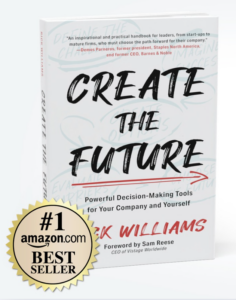
My Commercial: My leadership handbook, Create the Future, is your guidebook for team exercises for imagining and evaluating realistic options for your company’s future success, best matching your goals, risk preferences, and values.
This article was published in CEOWORLD Magazine HERE.
Insights on Setting Prices
Many of you responded to my newsletter – Raise Your Price – Find the Right Customer – with your own stories. I will pull the ideas and stories together for a future newsletter.
Setting a price for your product or services requires offering value to your customer. My friend, Attorney Geoff Chalmers, sent me these phrases and quotes:

Beauty is in the eye of the beholder.
“In the factory, we make cosmetics. In the store we sell hope.” Charles Revson, founder of Revlon.
“Tell me where is fancy bred – Or in the heart, or in the head?” William Shakespeare
Spring Flowers
Spring in New England is cold and wet. Flowers love it.
These red and yellow blossoms line a traditional stone wall in Concord, Massachusetts.

View Rick Williams’ Latest Blog Posts
Rick’s Newsletter
A newsletter with a CEO and Board of Directors’ point of view—get Rick’s blog in your inbox:
By submitting this form, you are consenting to receive marketing emails from: Rick Williams. You can revoke your consent to receive emails at any time by using the SafeUnsubscribe® link, found at the bottom of every email. Emails are serviced by Constant Contact